A writer across all media and methods as possible and appropriate.
Raised in Des Moines, Iowa, I scholarshipped in Debate at Augustana College in Sioux Falls, SD; the University of Northern Iowa in Cedar Falls, IA and Pace University in New York City. Currently living in a suburb of the Minneapolis-St. Paul metropolitan area, raising a teenage artist.
Drake Street is a five-act stage play which takes place along a magical street in Des Moines, Iowa. I wrote it primarily for Jr. High and High School students, for in-class readings and other school uses. It features two Otis Redding songs, Try a Little Tenderness and (Sittin’ on the) Dock of the Bay.
A few of the characters you’ll meet include a young Amelia Earhart, an old George Washington Carver, his friend Henry A. Wallace with his new hybrid seed corn, radio announcer Ronald (Dutch) Reagan, the five founders of the National Negro Bar Association, Harriet Tubman leading fugitives up the Des Moines River, local jazz pianist Speck Red and others who together showcase a blend of perseverance, invention and creativity.
I am humbled to be a part of their journey. And I have learned that their perspective is beautifully different, even if at their age they might not find the words to explain why they formatted their picture differently.
(This story has been updated as gender-neutral, which my child appreciates.)
Three years ago when my only child was in 2nd Grade their Art class studied Vincent Van Gogh. I was impressed with their description of his changing hues over time, the memory of Don McLean’s “Starry Night” tribute to Van Gogh remote in the background of my mind.
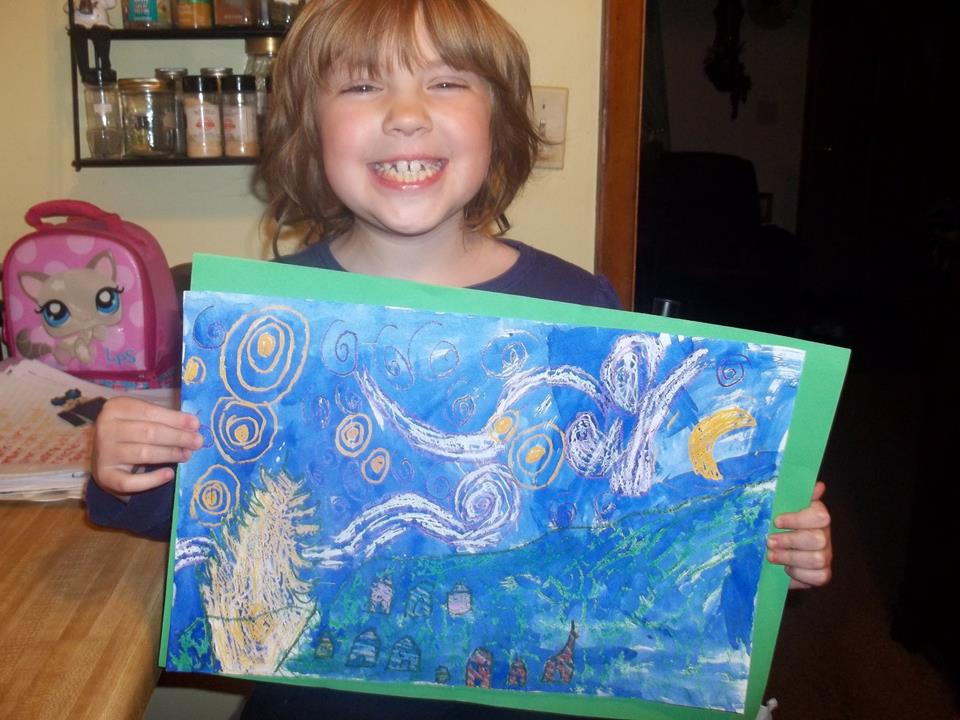
One day when I picked them up from school they had this wonderful version that they fashioned after his painting, which they had affixed to its matting quite uniquely and in a fashion I thought Vincent would have probably appreciated. A few weeks later at an Open House we toured the school and one hallway had dozens of other 2nd Grader’s renditions of this painting hanging side by side along the top of the hallway, all squarely matted with the same amount of edging all the way around. And then I realized that my child’s version was not being displayed with the others. Perhaps it was too Atypical. Perhaps other parents wouldn’t understand whatever artistic statement they may have been trying to make as a student who seldom spoke at that time.
That same year their school helped us with a discovery. After asking my permission to test them to see if they qualified for special education support services the school determined that they did, based on their scores from a variety of mental and physical tests. The day that the school asked me for permission to test them I attended a meeting in a room adjacent to the school office a half hour before school started. Their teacher, school psychologist and a couple special education teachers were there, then others started to arrive — a gym teacher and other teachers and specialists who had interacted with or observed them — even the principal.
As the team went around the table reviewing their notes with me I began to see a pattern of traits being describing which mirrored to some extent the TV character Max Braverman in “Parenthood” and I said, “This sounds a lot like Aspergers.” The staff all looked at me, it seemed as if to see how I was handling that new revelation, and when it appeared that I was maintaining my composure the principal smiled and excused herself and each of the teachers and specialists followed suit until I was alone with the school psychologist and a couple special education teachers. It wasn’t until I left the building that I realized that several of those folks were there to offer me emotional support.
The following year, after finding and following several Facebook pages by parents of Autistic children, I took my child to a neurologist for an official diagnosis, faxing their test results to his office the day before their first session. He met with us and asked to see the folder I brought those test results in. Flipping through the pages, he pointed to a chart of their IT scores. “Do you see that number? Only 1% of the people in the world can score higher than that. It’s their long-term memory.” I smiled to think that we would probably never meet any of those 1%, then laughed because I had just attended a conference to see an Autistic speaker and her mother, Temple Grandin and Eustacia Cutler, and I had purchased a book which Dr. Grandin autographed to my child titled “Thinking in Pictures.” Temple Grandin might score higher on that test.
I believe that advocacy is born of necessity and is empowered by understanding, continuing education and enlightenment — and outreach. Before I considered myself any kind of advocate I had a long journey with my child, to understand them better and to be a better listener and ally. Reaching out to different support groups on Facebook, I learned from Autistic adults who invited me to join other groups, some for supporting each other and other groups for advocacy. I began to see my child’s sensory issues more clearly in advance and help them develop ideas for managing that sensory environment — from clothing to too much noise. Their Autism journey has known many challenges and difficulties while also showing incredible intellectual and artistic abilities.
I am humbled to be a part of their journey. And I have learned that their perspective is beautifully different, even if at age 7 they might not find the words to explain why they formatted their picture so differently. They studied Van Gogh and came to their own very unique opinion in response to a question that they alone imagined: “What would Vincent do?” They are their own advocate. I’m just a fellow sojourner in this strange land of learning and understanding and seeing the world more Atypically.
My child’s version of Van Gogh’s Starry Night in their 2nd Grade Art Class


 Drake Street Productions